William Board
D E S I G N & T E C H N O L O G Y
P E R S O N A L P O S I T I O N
Exploring your own position on Architecture is a changing, dynamic experience that is constantly evolving from influences within the architecture school, the outside world and personal experiences. Over the past two years during the March course I have been particularly interested in the analysis of everyday activities, how these can inform architecture and the role of them in a city wide context. These occurrences have been enhanced by my studies being based in Mumbai, India where the infrastructure of the city has to cope with the mass of people. Through studying various articles on this a description of the city being Kinetic has been influential. The kinetic city is the ‘temporal articulation and occupation of space’ (Rahul Mehrotra). The kinetic city is not just the architecture of the informal, but where the boundary between informal and formal are blurred and the spatial limits of the city are expanded to include unimagined uses.
This issue has been explored through the medium of film as a way of portraying the experiences that currently exist and what is proposed by my design interventions, showing how the architectural world is in inhabited. It is used as a design tool to help investigate issues and spatial experiences.
The way we perceive the built environment is approached differently in architectural school to out in the profession. The techniques used to explore narratives within the design and the in-depth exploration of space is stunted often due to company’s commercial gains, limiting project briefs or contractors being in charge of designs. The socially engaged architect has been lost in most large scaled practices with only a small number of companies having the freedom to explore their potential.
D E S I G N S T U D I O C O N T E X T
The Design Studio ‘A Cinematic Construct of New Commons’ uses the media of film, the construct of a film essay, and the building of sets to explore and re-imagine the material and metaphorical concepts of the commons in both London and Mumbai. Using water as running theme through the studios student’s projects, areas within these cities are under analysis, to determine new approaches to the design of current and proposed infrastructures.
The film essay is used as an analytical tool to help investigate a problem identified in research in the city. Through the production of Sets, the initial information collected is not shown by info graphics on sheets of paper but given a three dimensional space to inhabit. The film essay enables me to immerse myself and the viewer in the situations and problems that are being explored throughout the course.
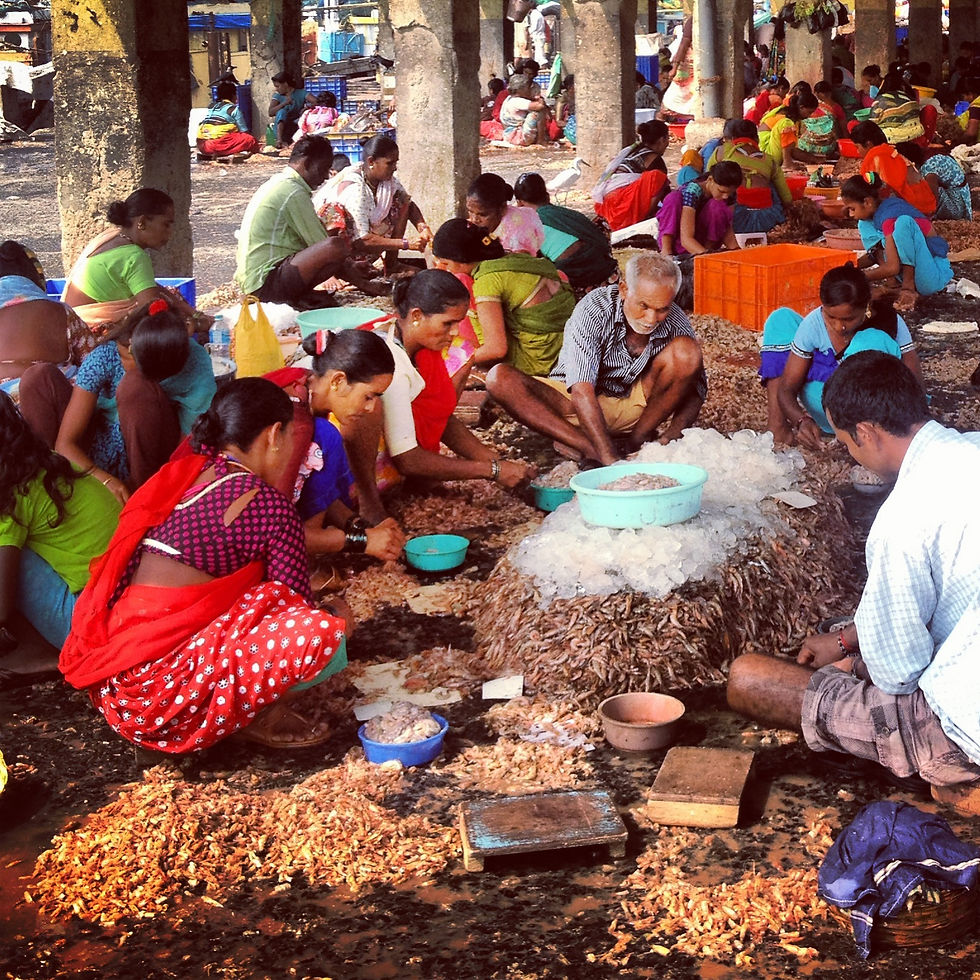
This helped me in the creation of an overarching narrative for the initial setting out of the both work in year one and two. In Year one creation of a film essay exploring street hawkers in both London and Mumbai allowed me to redesign spaces within the respective cities for this activity to occur. In my second year the film essay has allowed me to explore issues surrounding the Kolis population (fishing community). The use of film enables an easier way of documenting the city with subsequent analysis on return to the UK.
D E S I G N T H E S I S
The design project looks at the use of water as an infrastructural tool to navigate through the compact streets of Colaba, situated at the Southern tip of Mumbai. It explores the creation of a new route of water flowing and connecting between the East, Sassoon Dock and the West, Back Bay, Coast lines. This route is designed with two new infrastructures running in Parallel, one a proposed new canal system, connecting the interior of Colaba back to water and secondly a localised tram route connecting the different residential, industrial and commercial areas of Colaba together and up to the two southern most train stations, Victoria (CST) and Churchgate.
The initial reason for these proposed routes is to help reconnect the Kolis (fishing) population places of live, work and play back together, having being the original inhabitants of the seven islands of Mumbai. The community has been moved to the edge of the city over successive redevelopments, from colonial connections of the islands, reclamation projects and the Back Bay development, which was halted in the 1970’s. This has led the area to develop in to a series of congested streets and gated unused parks and gardens. Between the main area of inhabitation of the Kolis and Sassoon Docks the main fishing port in Mumbai there are three major roads that have to be crossed by the pedestrian Kolis.
The proposed canal and tram infrastructure has been designed for the benefit of the pedestrian, providing safe car free routes. Unused and derelict gardens, parks and ground floors of buildings are to be given back to the city as space for the infrastructure to take over and new commons to be formed. Within these new commons the Kinetic city can re-inhabit and determine daily how the space is to be occupied.
The project has evolved to the study the implications of the new infrastructures impact across the route at several key areas. Crucial programmes to help enable the Kolis population to inhabit these new commons are located along the routes. They include markets, street food, boat building, a new small dock on the western coast line and the reconfiguring of Sassoon Dock.
The focal point of the project has been the redesign of Sassoon Docks to enable a better work environment for the Kolis population and meet EU health and safety regulations for fish to continue to be exported out of India. Several programmes such as ice production units and desalination plants are currently not taking place within the dock and are trucked from elsewhere in the city.
Within my design a new set of architectural typologies have been designed, using the construction methodology of the canal, the main material being concrete, to establish a secondary distribution of water around the dock for, desalination processes, cleaning of water, water storage, ice production, ice storage, water for washing, prawns and fish, clothes and fishing community.
This series of architectural typologies can then expand out of Sassoon dock and start to create alternative infrastructures along the rest of the route of the canal and tram system.
T E C H N I C A L & T E C H N O L O G Y
Throughout the design process there have been a number of key components of work that have advanced my project. This started with the initial film essay exploring the Kolis population in Mumbai, using found footage I was able to gather a large quantity of information about my eventual topic, piecing them together to create a narrative and brief for the initial stages of the project. The creation of storyboards, being large composite pieces of work has enabled me to explore how characters would inhabit current and proposed spaces. This has been further enhanced by the creation of physical sets from the storey board to critic key spaces or moments within the project, when filmed and inhabited with props. To convey the overall master plan of the scheme axonometric drawings have been produced to achieve a three dimensional understanding of the spaces designed. The axonometric have been inhabited by the programmes, people, machinery and vehicles that would be present in reality to further the understanding of the spaces created.
To help enable the design process a series of technological and environmental reports were produced. Tge first report was to understand the climatic and historical setting of the project. This report looked at the environment of Mumbai being a hot, humid, tropical climate, and the implications this may cause for the creation of large bodies of water (evaporation), ice production units and storage (melting) and how to provide shading, cross ventilation and temperature controlled environments. This report also looked into the construction technique of the canal system using in-situ sprayed concrete.
The second report looked at the detailed technical re-design of Sassoon Docks, in particular the implementation of a series of inhabited walls, providing water transportation around the site. The construction technique for these walls was in-situ reinforced concrete to provide spaces and commons for the production of ice, desalination plants and transportation of the water. The report subsequently looked into the environmental aspects of the design, creating large overhangs for shading of programmes and the internal environments of for the production of ice.
The final report looked in depth at the construction methodology of the concrete as the main material to be utilised in the design. The material build-up of the concrete was explored by examining the strength of each element making the concrete, the appearance and aging processes. Subsequently the construction of the formwork to create the structure was explored through the use of recycled parts of buildings and boats to create the formwork, embedding the past narratives into the concrete. The materiality of each component and the end use of the formwork are explored so that it can be utilised within the design. This led to a construction sequence of one element of the design exploring how each part would be assembled, the large amounts of formwork material needed and the difficulties encountered by the creation of the parts of the formwork.
F U R T H E R D E V E L O P E M E N T
Due to the large scale of the proposal, consisting of the canal and tram routes and the large redevelopment of Sassoon Docks I have not been able to resolve all spaces of the design. If I could carry the project on I would like to have a detailed plan for every part of the proposed scheme. In the project so far I have chosen to study the areas that I thought were key. To enabled a more detailed design an additional field trip to Mumbai would be needed to further understand the current conditions and the changes throughout the year. I would like to be able to set up meeting with more of the Kolis fishing community to understand their needs and set up a meeting with the Mumbai Port Trust, to understand their proposals for the dock. I would like to hold another exhibition out in Mumbai solely on my research and design of the dock to get feedback from the population of Mumbai. This I would hope could influence the decision making processes of the development to allow flexibility in the design for the kinetic city to inhabit.
I would hope some of the research I have undertaken could then go on to inform development proposals for other Kolis communities within Mumbai and possibly outside of India.



Formwork set filmed at Leeds Film School.

Indentations into the ground floor creating pools of water and new commons.

Set Model showing the construction of formwork. Set to be filled with concrete for textural relief.
Formwork set filmed at Leeds Film School.

The red dot indicated where the site is in relation to the rest of Mumbai.

The plan indicated the routes of the new tram course (in green) and the canal system.
The red dot indicated where the site is in relation to the rest of Mumbai.

A series of components that inform the proposed design along the routes of the Canal and tram system.

Axonmetric drawing of infrastructures placed in Sassoon Dock. Highlighting the distribution of water across the site.
A series of components that inform the proposed design along the routes of the Canal and tram system.

Directing shots of my set model as a workshop in Leeds Film School, April 2015

Analysis of parts of disused boats that could be used to create formwork for the construction of the concrete structures.
Directing shots of my set model as a workshop in Leeds Film School, April 2015
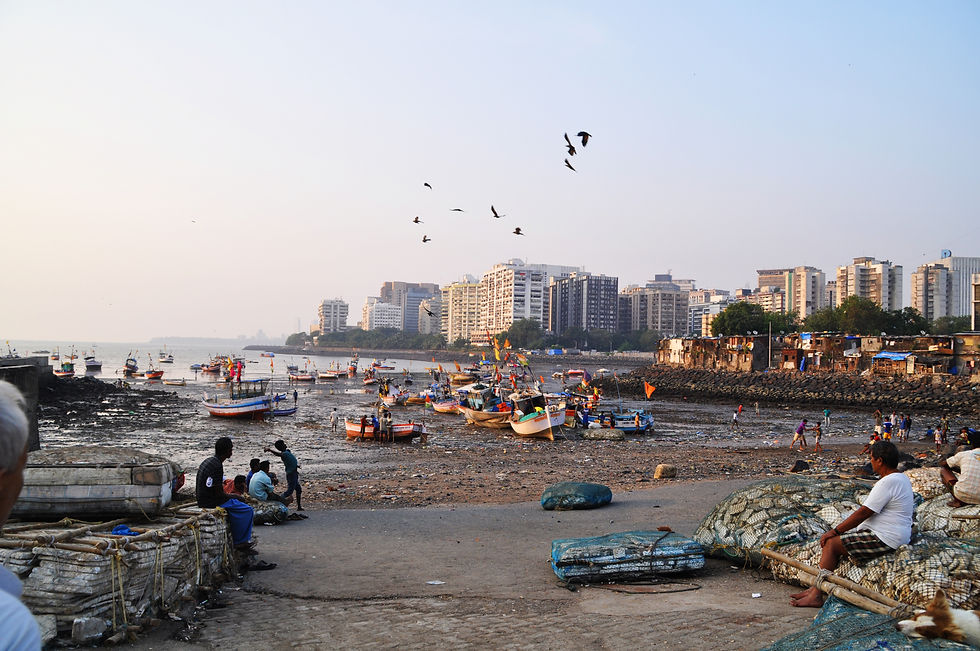
The view from the slipway from the Kolis Village in Colaba, Mumbai. The area is tidal often leaving boats stranded.
The view from the slipway from the Kolis Village in Colaba, Mumbai. The area is tidal often leaving boats stranded.