William Board
L I V E R P O O L S T R E E T
The new Crossrail station at Liverpool Street will serve the City of London and provide interchanges with London Underground’s Northern, Central, Metropolitan, Circle and Hammersmith & City Lines. It will also provide connections to Stansted airport and National Rail services at Liverpool Street and Moorgate as the new underground platforms will run between the two stations with entrances and exits at both.
To construct the new line below Liverpool street areas of the surrounding streets have been cornered off, changing temporarily the commons. These are along Broadgate street where the new ticket hall will be, Moorgate street where the existing entrance to the underground is being modernised and in Finsbury circus where a large hole has been excavated to allow access down to create the stations.
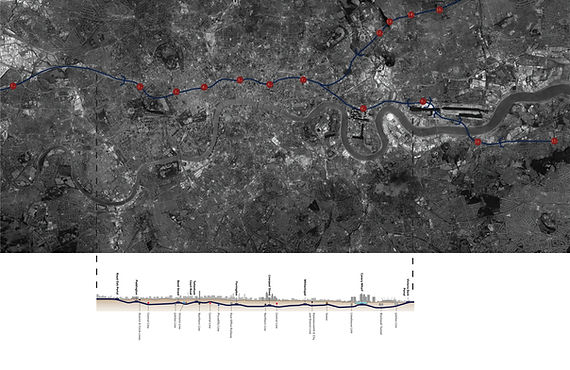
Crossrail Route
1. Acton Main Line, 2. Paddington, 3. Bond Street, 4. Tottenham Court Road, 5. Farringdom, 6. Liverpool Street, 7. Whitechapel, 8. Canary Wharf, 9. Custom House, 10. Woolwich, 11. Abbey Wood, 12. Stratford, 13. Maryland, 14. Forest Gate, 15. Manor Park, 16. Ilford, 17. Seven Kings.

Liverpool Street
1. Barbican, 2. Moorgate Station, 3. Finsbury Circus, 4. Bloomfield Street Site, 5. Broadgate Ticket Hall Site, 6. Liverpool Street Station, 7. Spitalfields
F O R E N S I S
Archaeology
Investigations before the commencement of the new ticket hall found that the position coincides with a hidden burial ground. This burial ground was London’s first extra-parochial burial ground, it was known as the New Churchyard, Bedlam, Bethlehem Churchyard, and later as the Bethlem Burying Ground. It was built upon land that belonging to Bethlehem Priory Hospital, London’s first institution for the mentally ill.
Construction work has begun at Liverpool Street to move services to make way for the new ticket hall. This has involved the extraction of numerous burials that have given archaeologist an insight into this time of London. Evidence of diseases and mental illness can be found in the bones.
The excavation work at Liverpool Street will involve the removal of the estimated 3000 bodies remaining on this part of the burial ground.
Deeper below the surface Roman remains have been found including 20 skulls, possibly washed down the hidden River Wallbeck from a known Roman burial ground. Also found is an old roman road, horse shoes and gates.

Extract of Agas Map of London 1553
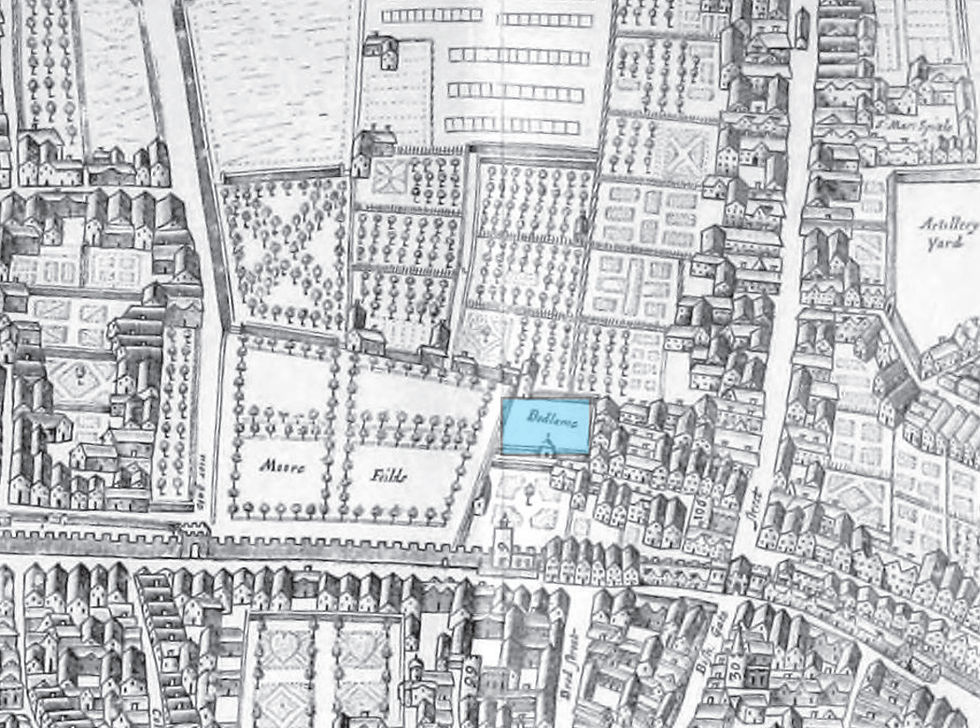
Extract of Fairthorne and Newcourts Map of London 1658
Maps showing Burial Ground
Two maps showing how the city of London grew around the New Churchyard.
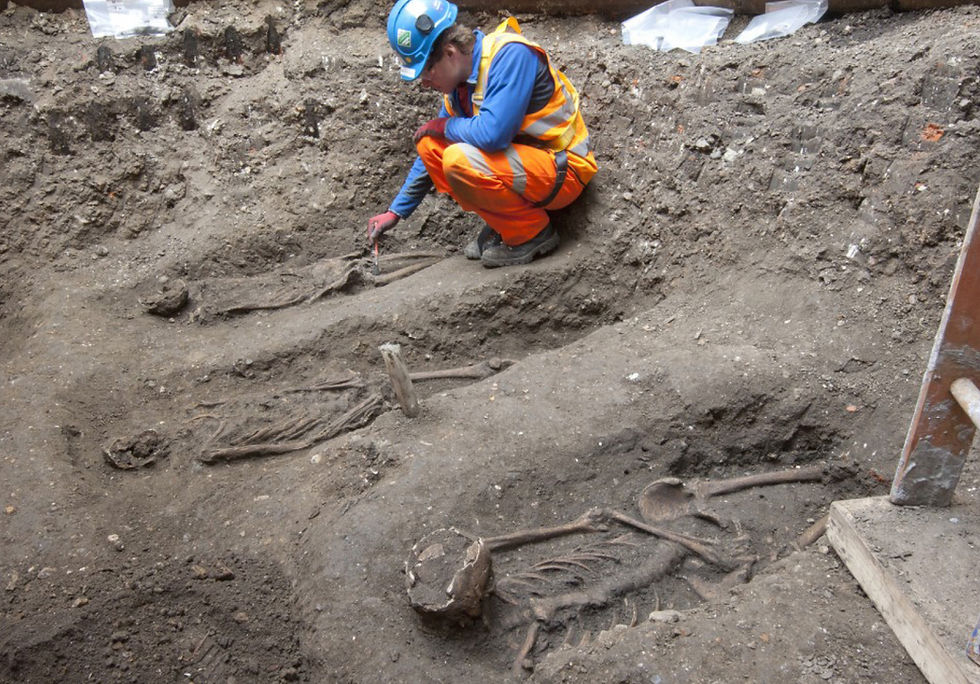
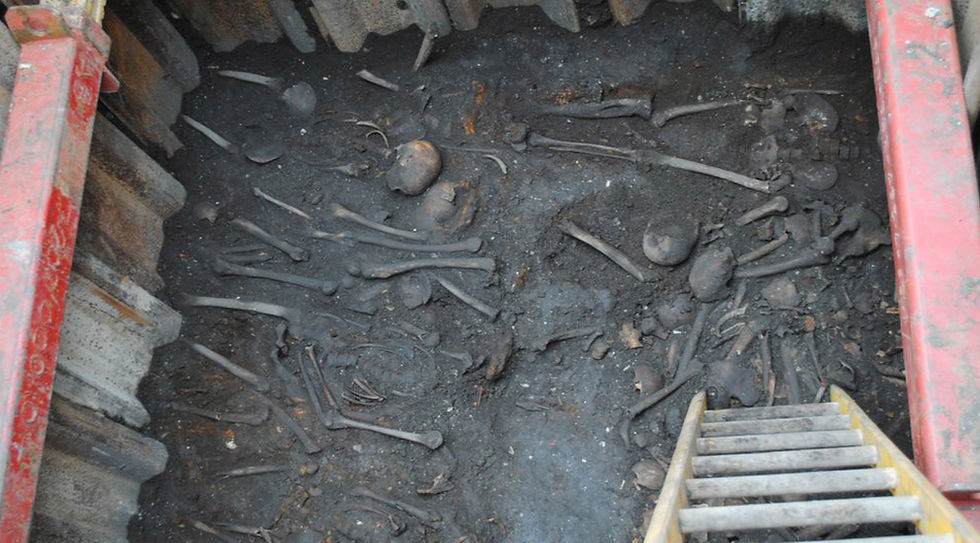


Excavations at Liverpool Street
A series of images from the excavations of the New Churchyard and Roman remains found 6 meters below the surface at Liverpool Street.

Forensis Archaeology
Forensis drawing looking at the archaeology excavations at Liverpool Street.
Construct of Crossrail
To construct Crossrail, engineers have to occupy large areas of London, access to sites, Storage of equipment and material and to aid in tunnelling; most of these occupied spaces or holes dug will be filled back in/ restored to how they were before Crossrail. Around Liverpool Street there are various locations being temporarily used as shown on the diagram.
At Finsbury Circus a temporary 42 metre deep shaft has been built to act as the ‘nerve-centre’ for the construction of Crossrail platforms, tunnels, concourse and passages to link the new eastern and western ticket halls at Moorgate and Liverpool Street. The shaft provides access for the construction of more than 1.5km of tunnels and cross passages, created by using Sprayed Concrete Lining techniques. At the base of the hole four tunnels branch off in different directions to form the central passageways and cross passages at platform level.

Diagram Map of Liverpool Street
A diagram map showing the extent of works and required works for the construction of Liverpool Street.
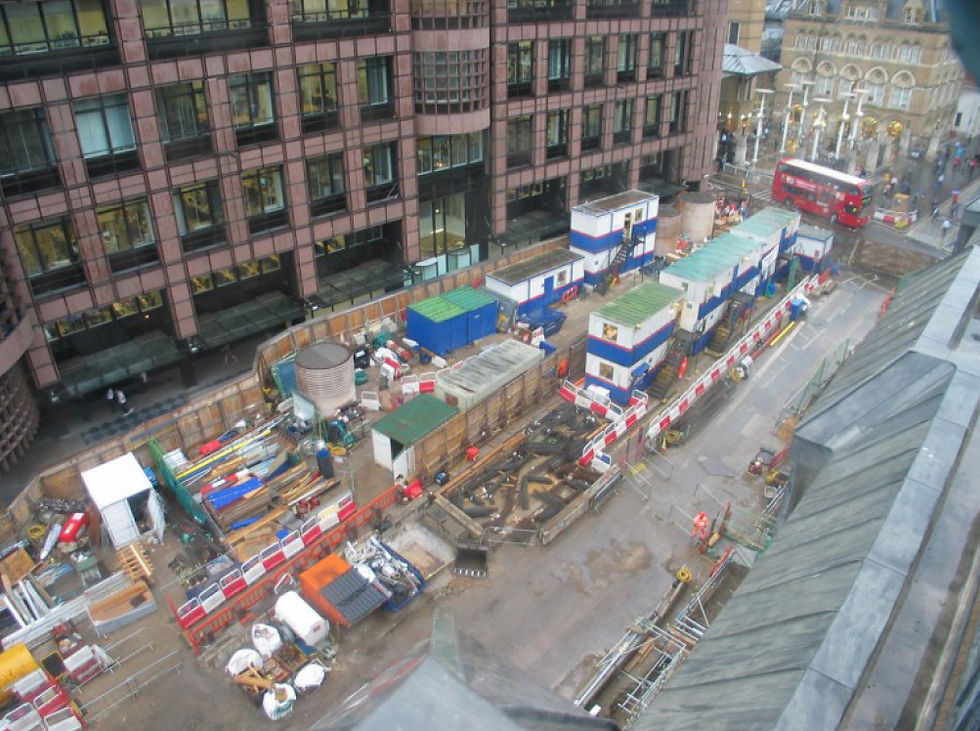
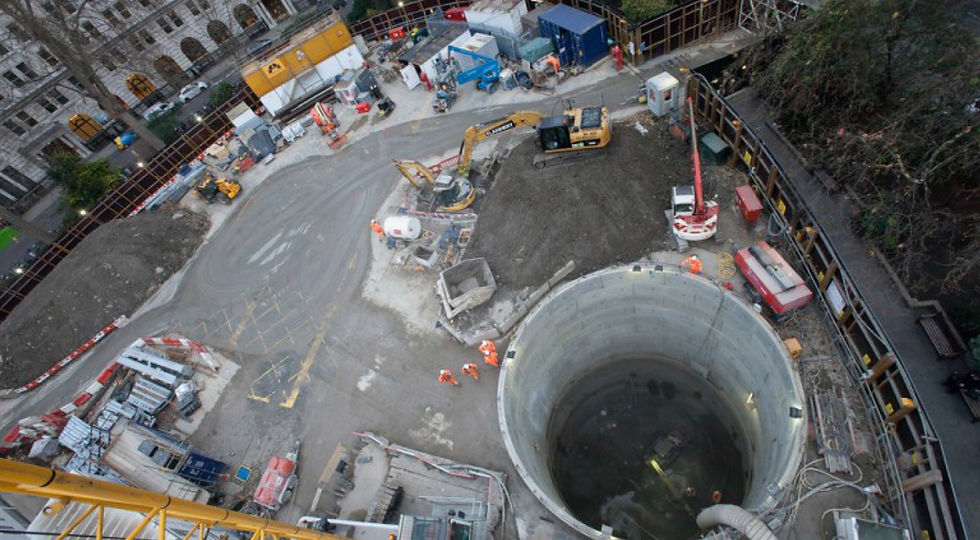
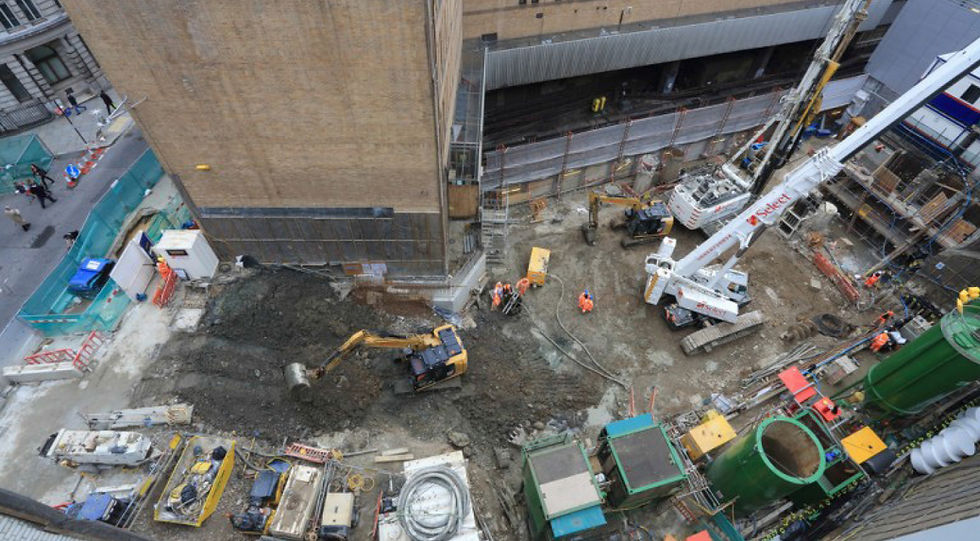
Excavation works for Liverpool Street
Images of the excavation and building works for the Crossrail Station between Liverpool Street and Moorgate Street Stations.
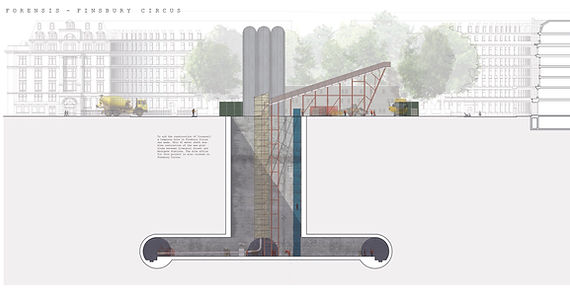
Forensis Construction
Forensis drawing exploring the construction of Crossrail at Liverpool Street and the construction of a temporary shaft in Finsbury Circus.
P R O J E C T
The project came from these two differentiating areas of research and trying to think of how the issues that they have created and coming up with a solution.
At the present time there has been no decision made on where the 3000 bodies will be re-buried. The bodies excavated so far are housed in the Museum of London where archaeologists are finding vast amounts of information from these bodies.
To excavate the hole at Finsbury Circus all the soil has been removed from site. The concrete structure has been built as a temporary construction to be filled in after station works are complete.
The project came from these two problems of finding space to re-bury the bodies and the temporary nature of the hole. The project looked into how the bodies could be 're-buried' into the hole, but also can be viewed by the public to find out information about the important role this area of London played.
The project explored many different ways in which bodies could be displayed in the cylindrical volume. The project was a conceptual idea where visitors walked around the perimeter of the cylinder, with walkways attached to the sides and the bodies suspended in another cylindrical structure within the walkway with a gap up the middle. The amount of bodies increased as the visitor walked down the structure.
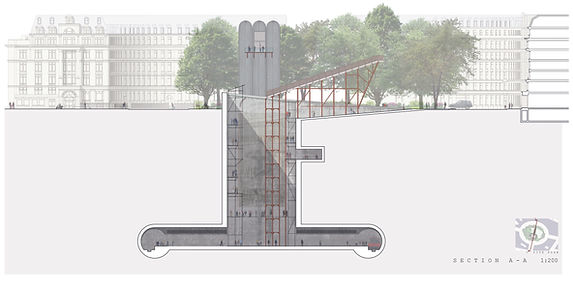
Section
The section shows the changes from the forensis construction drawing to the proposed use of the hole at Finsbury Circus.
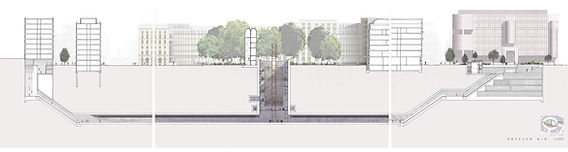
Section Along Route
The section shows the proposed project in context to the surrounding buildings. It cuts through the Crossrail Station from Liverpool Street Station (right) to Moorgate Street Station (left) and where it passes through Finsbury circus.

Close up Section
Zoomed in section of the proposed re-use of the temporary structure at Finsbury Circus. It highlights the re-use of existing structures found in the Hole and the site to use for the routes of visitors down. It also shows some rooms off the hole where other information can be found.